The short version
What happens when a selected area gets cold
- Heat moves out of the skin and underlying tissue toward the colder application.
- Local blood flow decreases and nerve signals can travel more slowly.
- Those changes can alter pain sensitivity and how a sore area feels for a time.
- The method, temperature, duration and treatment area determine the response.
First, the tissue has to cool
Cryotherapy begins with ordinary heat transfer: warmth moves from your body toward the colder application. Skin cools first. Deeper tissue responds more slowly, and the amount of cooling depends on the temperature difference, exposure time, body area, tissue composition and delivery method.
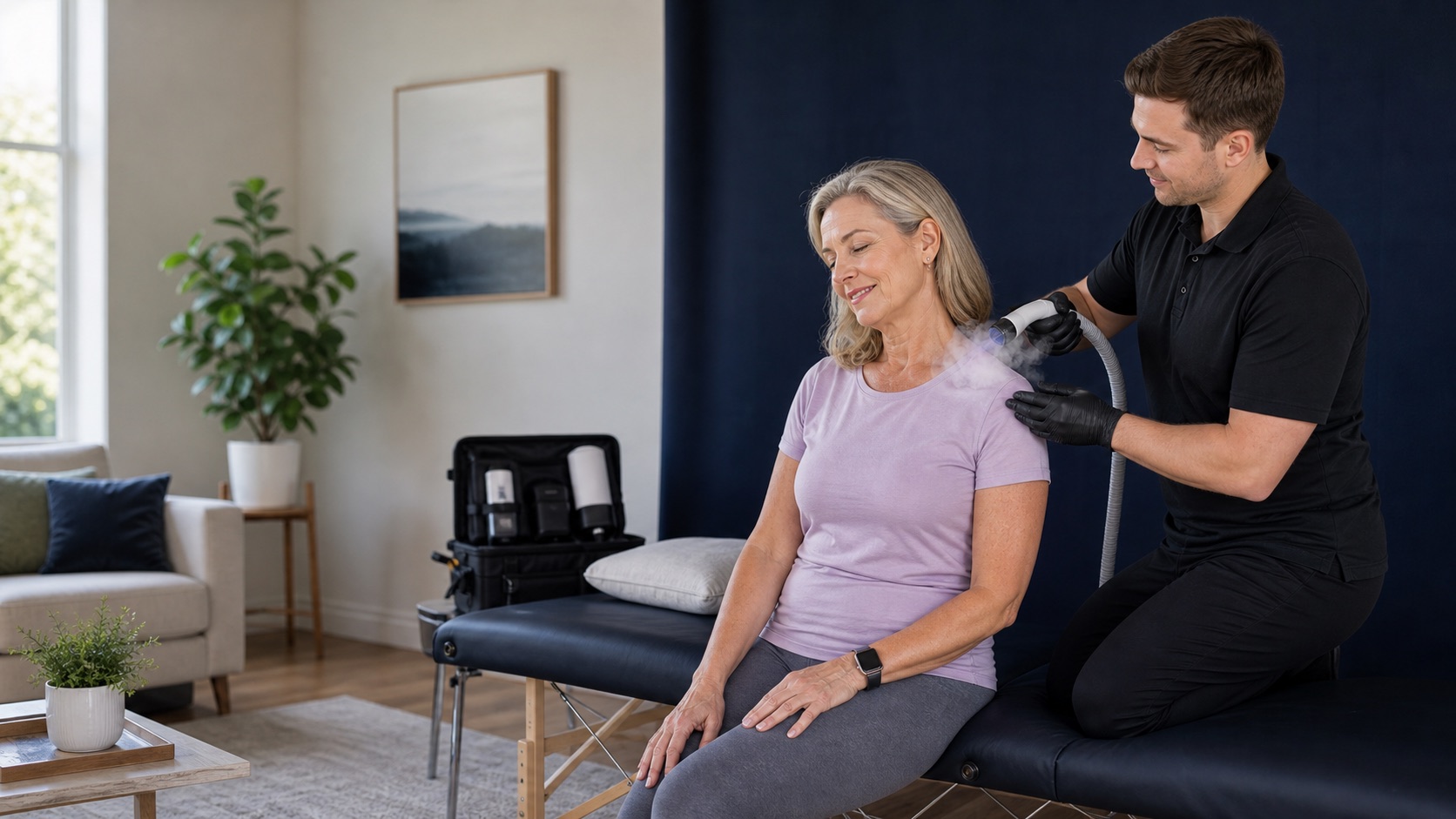
That last point matters. An ice pack presses against the skin. Cold-water immersion surrounds a limb or body. Whole-body cryotherapy exposes a large surface area to cold air. A localized device directs cold to one selected area. Each creates a different temperature profile, so their research cannot be swapped casually.
A useful exposure is controlled, tolerable and matched to the area and goal. The air or vapor temperature alone does not tell you how cold the tissue becomes.
Cold receptors respond almost immediately
Temperature-sensitive nerve endings in the skin detect rapid cooling and send signals toward the spinal cord and brain. That sensory input is why cold quickly feels sharp, intense or numbing even before deeper tissue has changed much.
Researchers describe a range of physiological responses to local cooling, including changes in tissue temperature, metabolism, blood flow and nerve activity.1 The size of each response depends on the dose. There is no universal minute-by-minute timeline that applies to every device and every person.
Nerve signaling can slow
As local tissue temperature falls, nerves can conduct signals more slowly. In a controlled study of ankle cooling, nerve-conduction velocity decreased while pain threshold and tolerance increased.2
This is one of the clearest explanations for temporary relief: the area is still there, but the sensory signal is being processed differently. That may create a useful period of improved comfort. It does not establish that the source of pain has healed or that a diagnosed condition has been treated.
Local blood flow changes
Cooling narrows nearby blood vessels, reducing blood flow at the skin. A study comparing four localized cooling devices measured this response with every device and found that reduced skin perfusion could persist while the area rewarmed.3 A later clinical study also documented persistent vasoconstriction after active cooling ended.4
That corrects a common marketing story. Rewarming does not necessarily create an immediate “rush” of circulation, and a blood-flow change by itself does not prove less swelling, faster repair or better performance.
- Skin and tissue temperature
- Cutaneous blood flow
- Nerve-conduction velocity
- Pain threshold and reported soreness
- Faster healing
- Resolution of an injury
- Disease treatment
- Permanent pain relief
What this may mean for soreness and recovery
For an active person, the most relevant outcome may be simpler: “How does the area feel later?” Research across cold-recovery methods suggests that some approaches can reduce perceived muscle soreness after strenuous exercise. A 2026 network meta-analysis reported that local cold therapy produced its largest delayed-onset muscle soreness reduction at 48 hours among the included studies.5
That finding is useful but not universal. “Local cold therapy” includes different equipment and protocols, and the pooled result does not guarantee the same response from a specific nitrogen-vapor service. It supports a reasonable recovery conversation—not a promise.
- ComfortA temporary sensory change may make a worked area feel easier to manage.
- Recovery routineA focused session can sit alongside sleep, nutrition, hydration and appropriate movement.
- Training decisionsFeeling better is useful information, but it is not medical clearance or proof that tissue is ready for full load.
Rewarming is part of the response
Once the exposure ends, skin and deeper tissues move back toward their usual temperature at different rates. Sensation and local circulation also normalize over time. The experience varies with the body area, cooling dose and individual response.
This is why an appointment should be guided by feedback rather than a dramatic fixed timeline. Speak up if the sensation becomes painful, burning or otherwise wrong. More exposure is not automatically more effective.
From physiology to a useful service
The reason to consider targeted cryotherapy is not a miracle story. It is a focused, convenient way to use a real physiological tool with realistic expectations.
A responsible provider should identify the exact method, review the selected area, screen for relevant risks, explain the expected sensation and make it easy to stop. Mobile Cryo Pro completes a brief intake and reviews the service before treatment. Dan brings the equipment to you, so the recovery routine can fit the location and schedule you already have.
If you want diagnosis, treatment of a medical condition or return-to-activity guidance, involve an appropriately licensed healthcare professional. If you want to explore a targeted cold service for short-term comfort or recovery support, start by asking Dan what the available option involves.
Sources & context
Research behind this guide
- White & Wells (2013), physiological effects of cooling (opens in a new tab)Narrative physiology review
- Algafly & George (2007), nerve conduction, pain threshold and tolerance (opens in a new tab)Controlled cooling study
- Khoshnevis et al. (2014), localized cooling devices and skin blood flow (opens in a new tab)Device physiology study
- Khoshnevis et al. (2016), blood flow during cooling and rewarming (opens in a new tab)Clinical physiology study
- Wu et al. (2026), cryotherapy methods and post-exercise recovery (opens in a new tab)Systematic review and network meta-analysis
The cited studies use different devices, body areas and protocols. The guide distinguishes measured mechanisms from clinical outcomes and does not treat one cooling method as proof for another.